
As many of you have probably heard or read in the news, Pertussis cases
are on the rise with numbers over double what they were at this time last
year. While this statistic is concerning, it is education about the disease and
its prevention that will hopefully begin to turn these numbers around.
Pertussis, more commonly referred to as “whooping cough,” is a highly
contagious respiratory disease caused by bacteria called Bordetella
pertussis. Symptoms often begin like the common cold, with a runny nose,
cough, and fever. However, the cough eventually takes on a high-pitched
“whoop” sound with fits that can come and go for weeks. These harsh fits
can lead to further complications like vomiting, cracked ribs, hernias,
pneumonia, and weight loss. In some cases, they can even lead to
seizures and encephalopathy.
Babies under the age of one are the most at-risk for Pertussis and its
complications, with immunocompromised individuals and those with
moderate to severe asthma following closely behind. Because it can take
5-10 days from exposure before symptoms first appear, it is very important
to avoid these populations if you know you have been exposed to Pertussis
and/or mask whenever possible to avoid spreading it to anyone else.
Transmission occurs via respiratory droplets that are sent airborne when an
infected individual talks, coughs, or sneezes. Therefore, proper respiratory
hygiene (masking, coughing and sneezing into an elbow) and hand
washing are incredibly important. There are antibiotics that an infected
person can take prophylactically if exposed or post-exposure if diagnosed.
But the best way to avoid illness is to make sure you are vaccinated.
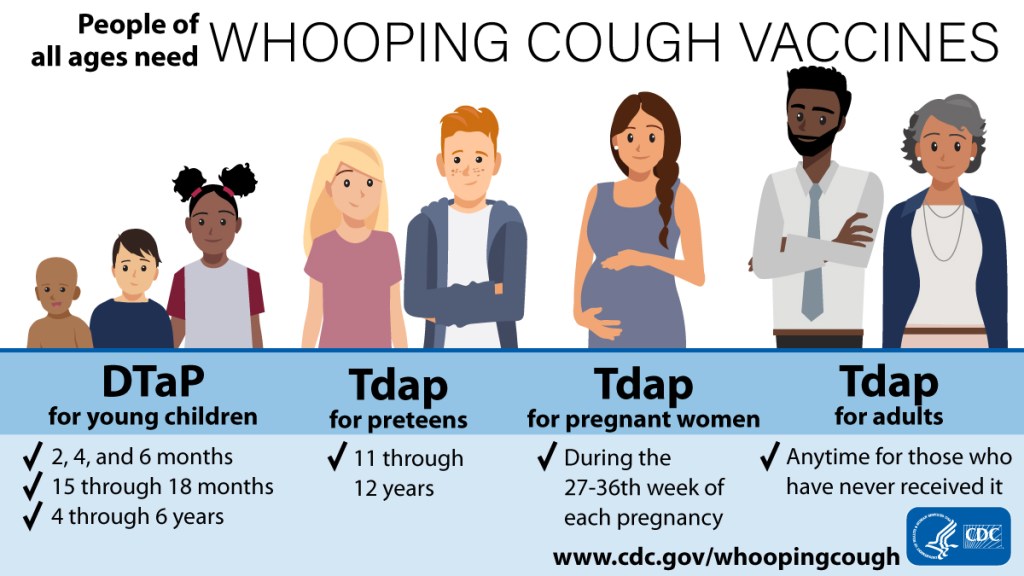
The Pertussis vaccine is part of a combination vaccine known as DTaP (for
children under the age of 7) and TDaP (for anyone over the age of 7). The
“D” and “T” stand for Diphtheria and Tetanus. These vaccines are safe and
effective, providing almost 100% protection against Pertussis alone for
those who complete the full vaccine series.
Part of the problem we are experiencing globally is a decline in
immunization rates which is contributing to a decline in herd immunity.
Herd immunity occurs when a certain percentage of the population is fully
vaccinated against a disease, thus protecting those who are not
vaccinated. As our immunization rates dip, our risk of spreading disease
increases.
For more information about our vaccine schedule, visit our website: Routine
Check Ups | Pediatrics at Newton Wellesley
And as always, feel free to reach out to your pediatrician about any of your
concerns.
Sources:
https://www.cdc.gov/pertussis/about/index.html
https://www.cdc.gov/vaccine-safety/vaccines/dtap-tdap.html
 From the Triage Desk
Leave a comment